
 Tiếng Việt
 한국어
 日本語
Article
How Many Clothes Do You Need For A 7-Day Trip? How To Pack Light 2027
On this page
A 7-day trip does not mean stuffing your whole wardrobe into one suitcase. Most travellers pack far more than they need, which makes luggage heavy and adds airline baggage fees. This guide brings together concrete numbers, a field-tested packing list and the packing techniques that let you travel lighter while still having enough for every activity on a 7-day trip.
The lighter your luggage, the easier it is to leave it behind mid-trip, and if you check out early while your flight is in the afternoon or evening, luggage storage near Tan Son Nhat lets you walk around the city hands-free instead of dragging your suitcase along.
How Many Clothes Do You Need For A 7-Day Trip?
A 7-day trip realistically needs only 4 to 5 outfits if you plan to re-wear items, combine versatile pieces and use laundry services at your destination. The sections below run from the re-wearing rule and the numbers to the factors that push this count up or down.
The Smart Re-Wear Rule For A 7-Day Trip
The "smart re-wear" rule lets you stretch the life of each item by planning outfits in advance, cutting the number of clothes you pack to just 60% of what a conventional packing approach would use. An outer jacket can be worn for 3 to 4 days, jeans for 2 to 3, and underwear and socks are the only two items you change every day.
Many travellers make the mistake of counting the days and doubling that number in outfits. In reality, each group of clothes can be re-worn like this:
- Outer jacket: 3 to 4 days in a row without washing.
- Jeans or chinos of good quality: 2 to 3 days if you are not doing sports.
- Sleepwear or comfortable clothes: two evenings in a row.
- Underwear and socks: changed every day for basic hygiene.
How Many Tops For A 7-Day Trip
The figure most often recommended in the light-packing community is 4 tops, 2 bottoms, 7 sets of underwear and 7 pairs of socks for a 7-day trip with no formal events. If there is a gala or an important meeting, just add one smart outfit and never pack more than one spare item.
The 4-2-7 formula is flexible enough for most kinds of trips: a beach holiday, city exploring or a short trip combined with business. If the trip includes a gala evening or an important meeting, you only need to add one smart outfit. There is no need to pack more than one spare item, because most destinations have convenience stores or supermarkets selling the essentials.
| Item | Quantity | Notes |
|---|---|---|
| T-shirts and tops | 4 | 3 everyday tops and 1 top that works for evenings or restaurants |
| Trousers | 2 | 1 versatile long pair and 1 pair of shorts or sports trousers |
| Underwear | 7 | Changed every day |
| Socks | 7 | Changed every day |
| Smart outfit | Add 1 | Only if there is a gala or an important meeting |
| Spare clothes | 1 item at most | Most destinations have convenience stores or supermarkets selling essentials |
The 4-2-7 formula is for a 7-day trip; on a short 3-day trip the number of items drops while the re-wear and mix-and-match principles stay the same, and the compact luggage checklist for a 3-day trip applies exactly those principles to each type of item.
Factors That Change How Many Clothes You Need
The four main factors that directly affect how many clothes to pack are the destination (climate and culture), the activity schedule, whether you can do laundry on the spot and the type of suitcase you use. Tropical destinations let you pack less, while a winter trip adds a lot of volume even if the number of outfits barely changes.
Specifically, the three situations that change the quantity most are:
- Tropical destinations such as Da Nang, Phu Quoc or Nha Trang in summer: pack less because light clothing takes up very little volume.
- Winter trips to Da Lat, Sapa or Northeast Asia from December to February: you need extra thick jackets and warm layers, so the volume rises significantly even if the number of outfits barely changes.
- Outdoor sports such as trekking, running and swimming: you need 1 to 2 additional sets of specialised clothing.
A thick winter jacket takes up a lot of volume but is used only a few weeks a year, so after the trip wash it, dry it completely and put it into clothing and textile storage that prevents mould instead of stuffing it back into a hot, humid wardrobe.
7-Day Travel Clothing Packing List
The best list for 7-day luggage is built on one principle: every item must be wearable at least twice and match at least two other items in the same suitcase. Applying this principle, the final list consists of tops, two pairs of trousers, underwear and socks, plus one outer layer.
T-Shirts And Everyday Tops
T-shirts and tops are the backbone of 7-day travel luggage: easy to roll, light, quick-drying and able to match many kinds of trousers. The four tops are 3 in neutral colours and 1 with a pattern, preferring polyester-cotton blends or merino wool so they can be re-worn without holding odour.
- Quantity and colour: 3 T-shirts or round-neck tops in neutral colours (white, light grey, navy) and 1 top with a pattern or bold colour for a touch of accent.
- Fabric: polyester-cotton blends or naturally antibacterial merino wool so clothes can be re-worn without holding odour.
- Avoid: packing 4 tops in the same colour, because it gives no variety in souvenir photos and makes every day feel like the same day.
After the trip, technical clothing should be washed and dried completely before folding, and smart ways to organise clothes and belongings suggests how to split a wardrobe by season so travel clothes are always easy to pull out.
Jeans And Versatile Active Trousers
Two pairs of trousers is the standard figure for a 7-day trip: one versatile long pair for evenings and smart sightseeing, and one pair of shorts or sports trousers for daytime and outdoor activities. Thin jeans or stretch chinos are lighter than thick jeans, while board shorts that double as swimwear let you drop an item entirely at the beach.
- Long trousers: choose thin jeans or stretch chinos instead of traditional thick, stiff jeans, because the latter are heavy and take up a lot of volume in the suitcase.
- Sports trousers or joggers: useful for a morning workout and comfortable on long journeys by bus or train.
- Beach destinations: one pair of board shorts that double as swimwear solves both needs, so you do not have to pack separate swimwear.
Underwear And Socks For Light Luggage
Underwear and socks are the only two categories in 7-day luggage that must match the number of days, because they are worn next to the skin and changed daily for basic hygiene. Seven sets of underwear and seven pairs of rolled socks take up only about 1 to 1.5 litres, roughly a small shoebox.
- Quantity: exactly 7 sets of underwear and 7 pairs of socks.
- Fabric: naturally antibacterial modal, bamboo fibre or merino wool, so they can last 1 to 2 days in an emergency.
- How to pack: roll each set into a small tube and put them in one small mesh bag.
- Volume: all the underwear and socks for 7 days take up only about 1 to 1.5 litres, equal to a small shoebox.
Dress-Up Outfit And Outer Layers
If your schedule has special evenings such as a gala, a smart restaurant or a cultural event, limit yourself to exactly one smart outfit and get the most mix-and-match value from it with the items you already packed. One navy, black or charcoal blazer and one packable windbreaker are enough for both evenings out and sudden weather changes.
- Thin blazer: the smartest choice for 7-day luggage because it turns a simple T-shirt into an evening outfit.
- Blazer colour: navy, black or charcoal, because these colours match almost every other colour in the suitcase.
- Windbreaker or light packable jacket: essential for destinations where the weather can change suddenly; it works as a rain jacket, a warm layer at night and folds small enough to fit in a trouser pocket.
A blazer and other leather items used rarely on the trip should be stored separately so they do not lose their shape, and secure storage for handbags and leather goods sets out the conditions for storing leather when it is not in use.
Choosing The Right Clothes For Your Luggage
Choosing the right type of clothing from the start matters more than packing technique. The right clothes cut luggage volume by 30 to 40% compared with the same number of outfits in the wrong fabrics and colours. Fabric and colour decide volume more than quantity, so this section covers neutral colours, fabrics and the 48-hour rule.
The Neutral Colour Principle For Luggage
Building your luggage around 2 to 3 neutral base colours lets every item in the suitcase match every other, creating many different outfits from fewer clothes. Four colours, white, black, light grey and navy, are enough to make 8 outfits from 4 tops and 2 bottoms, plus small accessories to change the look.
- The four colours: white, black, light grey and deep navy are the four most dependable neutral colours for travel luggage.
- Number of combinations: from 4 tops and 2 bottoms in these four colours you can make 8 completely different outfits.
- Accent: add one or two small accessories such as a colourful scarf or a bag strap in a bold colour for visual interest without taking extra suitcase space.
Choosing Fabrics That Suit Travel
Three fabric criteria to prioritise for a 7-day trip are wrinkle resistance, fast drying and low weight per unit area of fabric. Merino wool is antibacterial, polyester-spandex dries in 2 to 3 hours, tencel and modal wrinkle less, and thick cotton is best limited.
| Fabric | Characteristics | How To Use |
|---|---|---|
| Merino wool | Leads in natural antibacterial and odour-resistant properties | Can be re-worn many times |
| Polyester-spandex blend | Light, stretchy and dries in 2 to 3 hours | Ideal for active clothing |
| Tencel and modal | Soft, wrinkle less than pure cotton and breathe well in hot, humid weather | Suits hot, humid destinations |
| Thick 100% cotton | Heavy, holds moisture for a long time and is very hard to flatten after being crumpled in a suitcase | Best limited |
Avoiding Excess When Packing
The 48-hour rule is recommended by many light-travel experts: after you finish packing, wait 48 hours, then open the suitcase and remove one third of what is inside. In practice that means trying each outfit in front of a mirror, listing the activities for each day and keeping only clothes that suit those activities.
- Try each outfit combination in front of a mirror: if two items cannot be matched, drop the less versatile one.
- List specific activities for each day (sightseeing, swimming, formal dinner, hiking...) and choose only clothes that suit that activity.
- Remove everything packed with the thought "just in case", because almost 100% of it will not be worn during the trip.
Packing Techniques For A Compact 7-Day Suitcase
The same amount of clothing, packed with the right technique, can save 20 to 35% of volume compared with ordinary folding, enough to turn a 20-litre space into 28 litres inside the same suitcase size. The three techniques below, rolling, using packing cubes and packing by weight order, each solve a different part of the problem.
Rolling Clothes To Save Space
Rolling clothes in the Ranger Roll style removes the air gaps between layers of fabric and turns each garment into a firm cylinder that stacks tightly like logs. Each finished roll is about 8 to 10 cm in diameter, stands upright in the suitcase and works best with T-shirts, polos, shorts and thin jeans.
The correct method has four steps:
- Lay the shirt flat.
- Fold the bottom hem up by 5 to 7 cm.
- Fold both sides inward along the width of the shoulders.
- Roll tightly from the collar down to the hem.
The folded hem at the bottom wraps around the roll like a sleeve and keeps it from coming undone. Each T-shirt rolled this way measures about 8 to 10 cm in diameter and easily stands upright in the suitcase. The method is especially effective for T-shirts, polo shirts, shorts and thin jeans.
Using Packing Cubes To Organise Luggage
Packing cubes do not let you fit more in terms of physical volume, but they remove dead space in the suitcase and let you organise clothes by category so they are easy to find without unpacking everything. A suitcase is usually split into 4 to 5 cubes by category, so at a hotel it takes only about 3 minutes to move clothes into the wardrobe.
Divide the suitcase into 4 to 5 cubes by category:
- A large cube for jackets and long trousers.
- Medium cube no. 1 for T-shirts and shirts.
- Medium cube no. 2 for sleepwear and sports clothes.
- A small cube for underwear and socks.
- A separate waterproof pouch for toiletries and personal items.
With this organisation, you only need 3 minutes to put things in the wardrobe when you arrive at a hotel and 3 minutes to repack each time you change accommodation.
For bulky wool and hoodies, the double-zip compression type is what really reduces volume, and packing cubes that make a suitcase more compact measures a reduction of about 25% to 40% compared with ordinary fabric cubes.
Packing A Suitcase In The Right Weight Order
Putting the heaviest items at the bottom near the wheels, lighter items in the middle and things you need quickly on top keeps the suitcase stable when pulled and stops light items from being crushed under hard ones. Shoes go at the bottom, heavy items in the middle, and toiletries and the phone charger on top so you can reach them straight after landing.
The standard order from bottom to top has four layers:
- Shoes at the bottom in a separate bag.
- Jeans and heavy jackets.
- The packing cubes with everyday clothes.
- On top, toiletries, the phone charger and anything you need right after landing.
Tuck a pair of rolled socks inside each shoe to use the empty space and keep the shoes from losing their shape during the journey.
Shoes sit at the bottom of the suitcase, so they must be completely dry before going into their own bag, and how to store shoes without mould gives the drying times and how to stuff them with paper to keep their shape after the trip.
The phone charger and other small electronics on the top layer should have cables coiled neatly and kept separate, and storing electronics safely sets out how to store devices and chargers so they are not damaged when left for a long time.
Luggage And Suitcase Storage While Travelling
The two most common situations that leave travellers needing luggage storage outside the hotel room are: checking out early when the flight is in the afternoon or evening, and wanting to see the city without dragging a bulky suitcase along. This section compares three options by how long you need to leave your bags: a locker for a few hours, self-storage by the month and a door-to-door suitcase pickup service.
An afternoon or evening flight after check-out is the most common reason travellers need somewhere to leave a suitcase, and safe luggage and suitcase storage in Ho Chi Minh City compares the options by how long you leave your bags, from a few hours to a few days.
The gap between check-out and the flight can last many hours, and what to do between hotel check-out and your flight in Saigon suggests how to use that time once your suitcase is stored.
Leaving Your Suitcase At A Ministop Locker 24/7
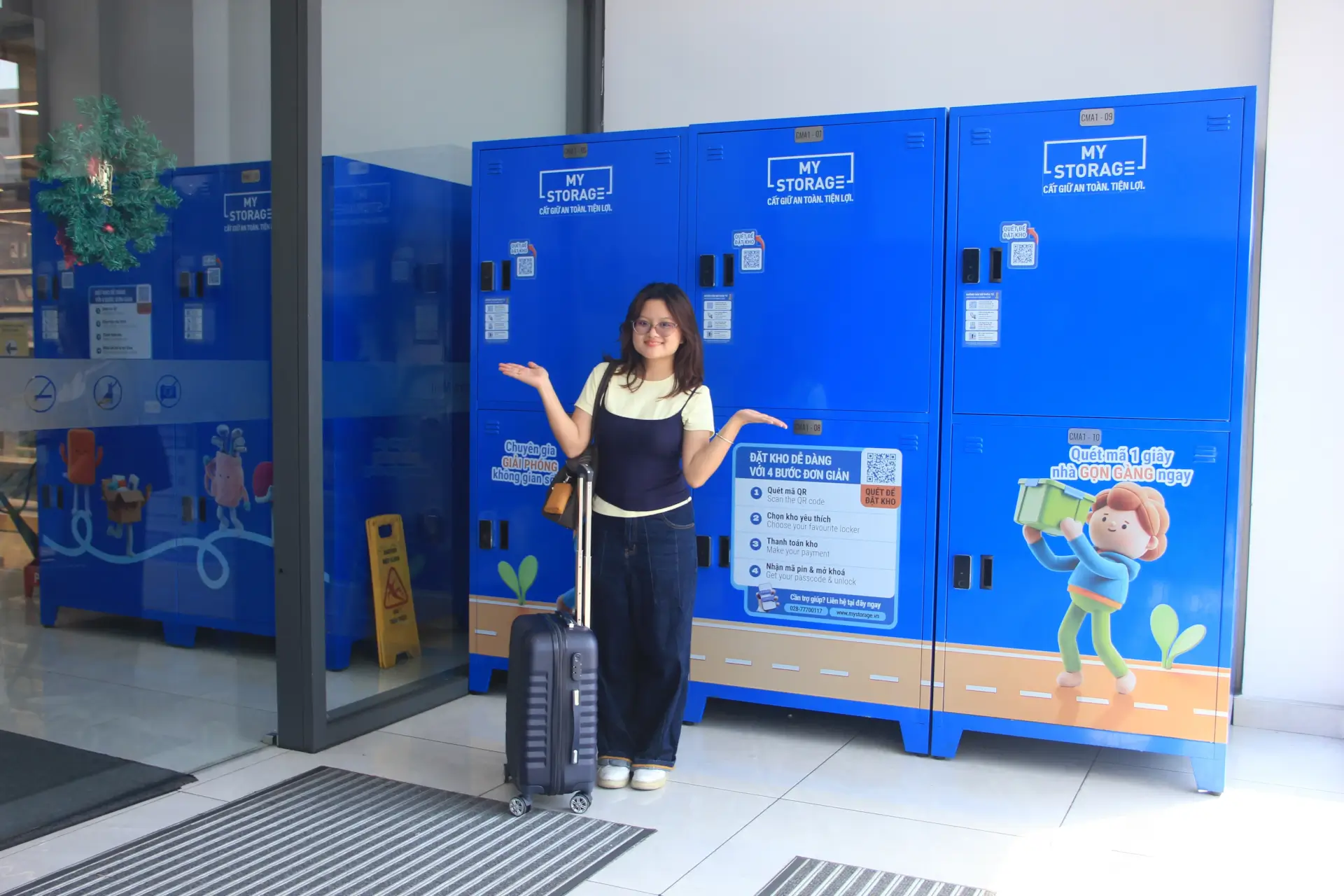
The smart locker system at the Ministop convenience store chain, open 24/7, is the fastest and most convenient way to leave luggage for travellers in central Ho Chi Minh City who want a few hours exploring hands-free. The lockers come in several sizes, are booked with a QR code and opened with a PIN, and suit best the window from midday check-out to an evening flight the same day.
- Booking and unlocking: scan the QR code on the locker to book, choose a locker, pay, then receive a PIN to unlock; leaving your suitcase takes about two minutes.
- Safe and dry: continuous camera monitoring and air-conditioning running 24/7 keep what is inside monitored and dry.
- Several sizes: from small lockers that fit a travel backpack to large ones that hold a size-28 suitcase.
- Locker locations: Ministop Tran Trong Cung (District 7) and Centre Mall (District 6).
- Best time window: from midday hotel check-out to an evening flight the same day, so you can eat and stroll without watching your suitcase.
Office workers also leave things at these locker points by the hour, and renting a locker by the hour for office workers explains how hourly pricing compares with daily pricing.
Self-Storage For Travel Suitcases
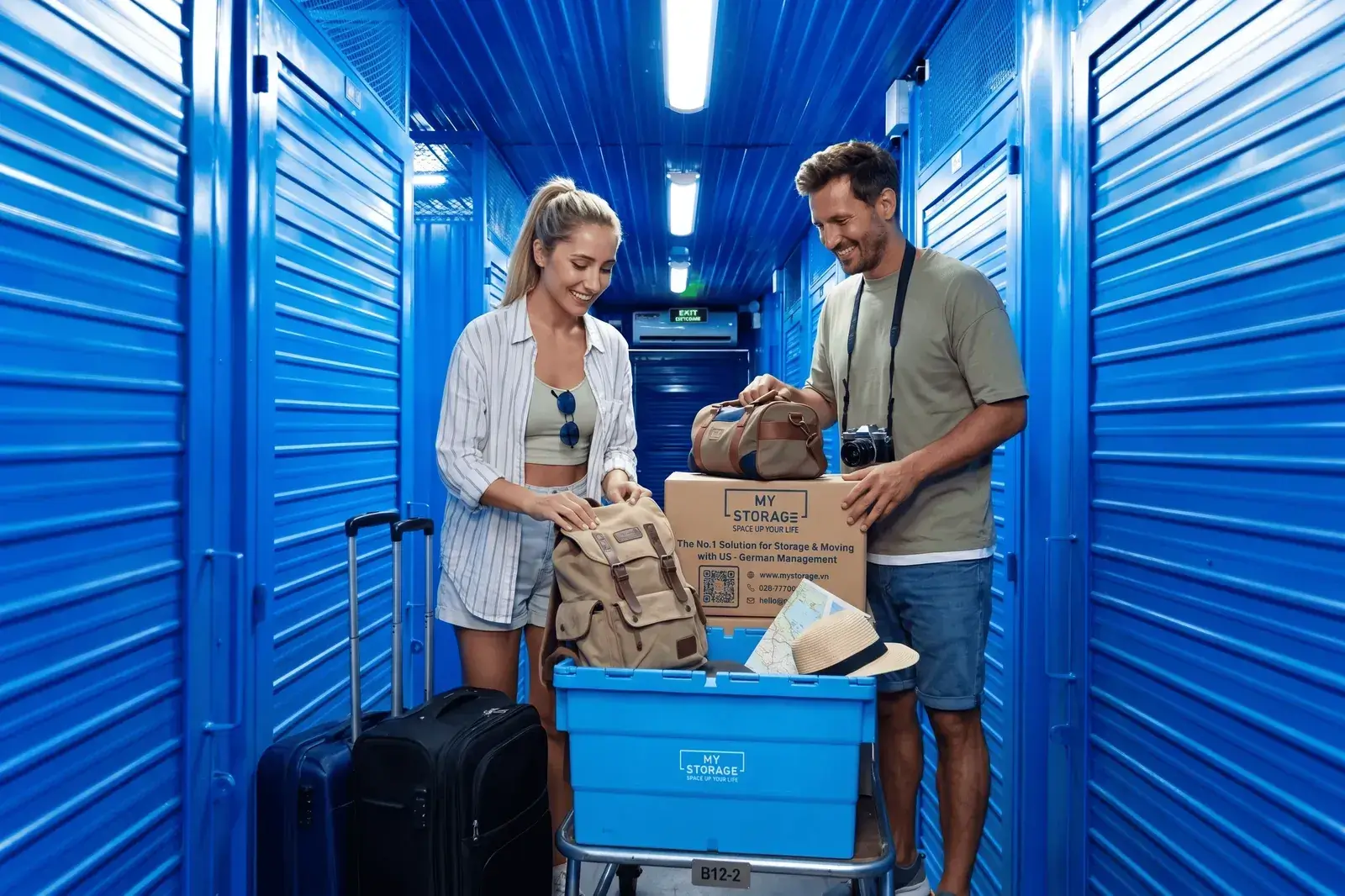
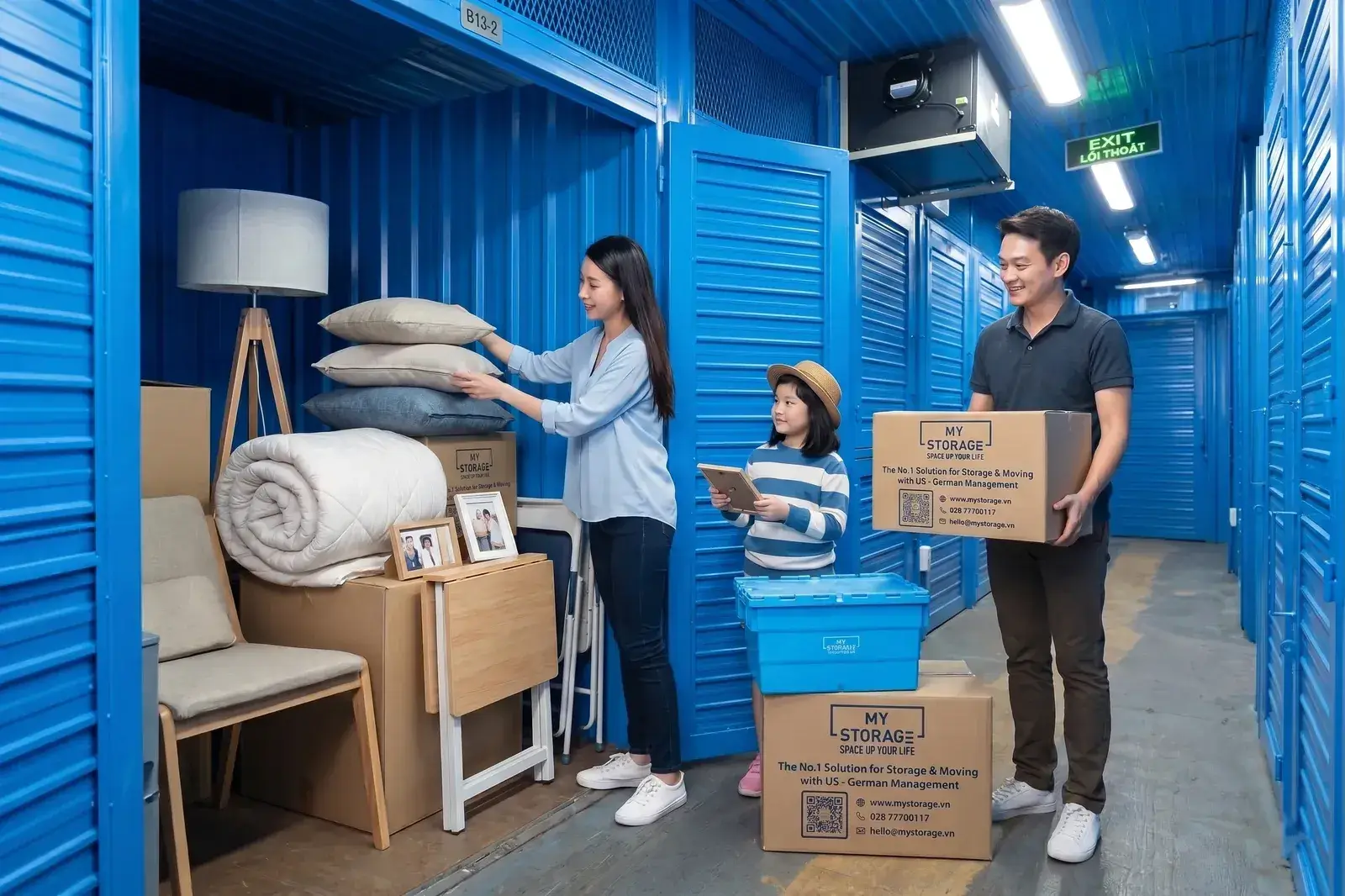
For longer trips or more than one suitcase, MyStorage self-storage offers private space from 1 m³ with temperature and humidity controlled by air-conditioning 24/7. Each unit has its own lock code and flexible access, which suits families going away for a long time or anyone who needs somewhere to keep an empty suitcase.
For someone who has just come back from a trip or is about to leave, a self-storage unit solves two things: a place for suitcases and everyday belongings, and access whenever you need them:
- Air-conditioning 24/7 keeps temperature and humidity steady for suitcases, clothes and documents.
- Security cameras protect your belongings for the whole storage period.
- Personal lock code issued to each customer, so only you can open your unit.
- 24/7 access, flexible at any time of day.
- Units from 1 m³, enough for a few suitcases and a backpack without renting a whole room.
- Workspace at 375 Vo Nguyen Giap for startups and online sellers to store stock and pack orders on site.
This is an ideal choice for families going on long trips who need to store everyday items from home before leaving, or for people in small apartments who need somewhere to keep empty suitcases after a trip. MyStorage has two self-storage facilities, at 375 Vo Nguyen Giap and An Phu Sports Park; lockers are a separate drop-off point for small items, not a storage facility.
When you have more than a few suitcases, household goods and luggage storage shows what a family-sized unit can hold, and renting a personal mini storage unit lets you start from 1 m³ and pay monthly.
Families going away for a long time also have to plan for the car and the things left at home, which where to store your car and belongings on a long trip covers group by group. For a suitcase holding valuables, ask carefully about cameras, access control and fire protection, the three layers that warehouse security systems analyses.
Door-To-Door Suitcase Pickup And Delivery
MyStorage’s door-to-door suitcase pickup and delivery service sends a vehicle to collect luggage right at your hotel or Airbnb door and return it at an agreed point on schedule, leaving travellers completely free-handed on their last day in the city. You only need to book one day ahead, and staff collect the suitcase at check-out time and return it at the point you chose.
- Book one day ahead through the app, instead of dragging a heavy suitcase from early morning until you get in the car to the airport.
- Staff come to collect the suitcase at your hotel room at check-out time.
- The suitcase is returned at the Tan Son Nhat airport gate or any meeting point in the inner city.
Full-journey luggage insurance ensures that any risk is handled transparently and quickly.
Compensation for luggage in transit differs between providers, so whether you need insurance when storing goods goes through which cases are paid and which are not.
| Service | Capacity | Storage Duration | 2027 Pricing Basis | Best For |
|---|---|---|---|---|
| Ministop locker | 1 cabin suitcase up to size 28 (about 0.15 m³ to 0.25 m³) | A few hours to 48 hours | Charged by the hour or by the day | Travellers leaving luggage between check-out and their flight |
| MyStorage mini unit | 1 m³ to 3 m³ (holds 2 to 3 large suitcases plus a backpack) | Flexible monthly | 873,000 to 1,563,000 VND per month (≈ US$34 to US$61) | People who need to store suitcases long term, small apartments |
| MyStorage family unit | 5 m³ to 7 m³ (holds all of a family’s travel gear) | Flexible monthly | 1,796,000 to 2,886,000 VND per month (≈ US$70 to US$112) | Families of 3 to 4 with lots of large luggage |
| Door-to-door pickup & delivery | No limit on number of pieces | Flexible by appointment | Free transport when you rent a unit | Busy travellers with no vehicle to carry suitcases |
Reference unit prices for 2027 exclude VAT, the 12-month plan is 15% cheaper, and 1 m³ holds about 8 to 10 medium cartons.
Storage is priced by the volume of the unit rather than the number of suitcases, and how mini storage prices are calculated breaks the rate into its parts, while storage priced by m³ versus m² helps you convert suitcases into cubic metres before you choose a unit.
Frequently Asked Questions About Travel Clothes And Luggage For 7 Days
The answers below cover the 15 most common questions from people preparing luggage for a 7-day trip, with detailed, practical explanations.
How Many Tops Should You Pack For 7 Days?
The optimal figure agreed by most light-travel experts is 4 tops for a 7-day trip: 3 everyday tops and 1 that can be worn in the evening or to a restaurant.
If you apply the smart re-wear rule, 4 tops are enough to make 7 days without repeating, by combining them with 2 different pairs of trousers and adding accessories. If the trip includes a lot of high-intensity sport such as hiking, running or surfing, you can go up to 5 tops, but choose quick-drying technical fabric so you can wash and wear them again the same day.
Should You Pack Extra Spare Clothes?
Pack only one single spare set for situations such as spilled food or getting caught in the rain; do not pack more than one set, because this is the main reason suitcases end up overloaded.
Instead of packing a full spare outfit, the smarter approach is to add one thin, light T-shirt and one pair of shorts. These two items take up very little space and cover most emergencies. If something bigger happens, supermarkets, budget clothing shops or local markets at most destinations sell clothes at reasonable prices.
What Size Suitcase Suits A 7-Day Trip?
A 40 to 55 litre suitcase is the ideal size for a 7-day trip if you carry only hand luggage, while a 60 to 70 litre suitcase suits better if you check luggage and bring back lots of gifts or purchases.
| Suitcase Type | Capacity | Best For |
|---|---|---|
| Cabin suitcase size 20 | About 36 to 40 litres | 4 to 5 days in light summer clothing, for people skilled at packing light |
| 24-inch suitcase | 45 to 55 litres | A full 7 days, holds everything comfortably without exceeding the carry-on limits of most Vietnamese domestic airlines |
| Checked suitcase | 65 to 75 litres | Winter trips or lots of sports gear, so packing is not a struggle |
Families travelling with young children usually add a stroller and toys, and storing children’s toys and strollers sets out how to rotate them so the suitcase does not have to carry extra.
Should You Do Laundry On A 7-Day Trip?
Doing laundry at least once, on day 3 or 4 of the trip, is the most effective tactic for cutting the clothes you need to about 60% of what you would pack without washing.
- Hotel laundry: most hotels of 2 stars and above offer on-site laundry or wash-and-dry priced by the kilo.
- Suggested laundry schedule: wash 4 to 5 T-shirts and 2 sets of underwear on the evening of day 3, hang them to dry overnight, and by morning you have a full clean set.
- Hand washing: technical polyester and merino wool can be hand-washed in clean water with mild soap, wrung out and hung to dry in 3 to 5 hours in an air-conditioned room.
How Do You Fold Shirts So They Do Not Wrinkle In A Suitcase?
Two techniques keep shirts from wrinkling in a suitcase: flat folding with a layer of support inside (the file folder method) for work shirts, and tight rolling (the Ranger Roll) for casual shirts.
| Technique | For | How To Do It |
|---|---|---|
| Flat fold with support (file folder method) | Dress shirts, blazers | Fold flat along the shoulders and slip a thin plastic board or plastic file folder inside as a shaping guide, so the garment keeps its flat shape throughout the journey |
| Tight roll (Ranger Roll) | T-shirts, sports clothes | Roll tightly and stand them upright in packing cubes, which gives fewer wrinkles than flat folding |
Place smart shirts that must stay flat on the top layer of the suitcase so other items do not press on them.
How Many Pairs Of Shoes For A 7-Day Trip?
The ideal number for a 7-day trip is 2 pairs of shoes: one versatile canvas shoe or sneaker for many occasions, and one pair of flip-flops or light sandals for the hotel and the beach.
Shoes take up the most volume and weight in a suitcase after a winter coat. Two pairs are enough:
- First pair: neutral sneakers or canvas shoes (white, black, grey) for walking the city and casual restaurants without being turned away.
- Second pair: flip-flops or light sandals for hotel use and the beach; if the trip includes trekking or forest walks, swap the sandals for light outdoor flats.
Do not pack 3 or more pairs of shoes for a 7-day trip, because the space and weight are better used on versatile clothes.
Suitcase Or Backpack For Travelling?
A 40 to 50 litre travel backpack suits trips with several stops, frequent public transport and many different places to stay. A wheeled suitcase suits a holiday at one fixed base for 7 days.
| Criterion | 40 To 50 Litre Backpack | Wheeled Suitcase |
|---|---|---|
| Best for | Multi-stop trips, frequent public transport, many places to stay; easy to carry over rough ground, stairs or dirt roads | A holiday at one fixed base for 7 days |
| Weight | About 30 to 50% lighter than a suitcase itself | Heavier than a backpack |
| Keeping clothes flat | Harder than with a hard-shell suitcase | Better, especially a hard cabin suitcase size 20 for smart clothes |
| Carry-on size | Not size-limited on some airlines | A hard cabin suitcase size 20 fits the overhead bin more easily than a backpack |
If the trip combines business and rest, one hard cabin suitcase size 20 holds enough and protects smart clothes.
A hard suitcase is bulkier than a backpack to store after the trip, so in a small apartment, smart storage for small apartments points out dead space such as under the bed or on top of wardrobes where an empty suitcase can go.
How To Pack Toiletries To Save Space
The 100 ml rule applies to carry-on luggage: every liquid, gel or cream must be in a bottle of no more than 100 ml, and all of them must fit in one small clear zip bag of 1 litre.
- Decant into small bottles: pour toiletries into small dedicated travel bottles instead of bringing full-size bottles from home.
- Bring only daily essentials: face wash, moisturiser, sunscreen, shampoo, shower gel and essential over-the-counter medicine.
- What you can skip: shampoo and shower gel, if you have confirmed that a hotel of 2 stars or above provides them where you are staying.
- Compact swaps: lip balm, make-up remover and toner can be replaced with wipes or quick-dissolving tablets to save as much space as possible.
Do You Need A Rain Jacket And Warm Layer?
A thin, water-resistant windbreaker is the most suitable substitute for both a rain jacket and a warm coat, because a single item solves both needs and folds to the size of a fist.
- Weight and size: packable jackets from brands such as Uniqlo, North Face or Columbia weigh about 200 to 300 grams and fold into a pouch the size of a fist.
- Use: it resists light to moderate rain, blocks wind effectively and works as a light warm layer.
- When you need a down jacket as well: only if the destination is below 15°C, such as Sapa at night or Northeast Asia in winter.
Trekking or camping trips also bring tents, sleeping bags and specialist shoes, gear that storage for fishing, camping and outdoor gear explains how to store so it is ready to use next time.
How Can You Make Your Suitcase As Light As Possible?
The simplest three steps to the lightest possible suitcase are: weigh the suitcase once packed, remove things you will not use in the first 3 days, and buy most toiletries at the destination.
- Weigh at home: buy a mini handheld luggage scale (about 100,000 to 200,000 VND, ≈ US$4 to US$8) and weigh your suitcase before heading to the airport.
- Weight target: carry-on under 7 kg and checked luggage under 20 kg, to leave room for things you buy.
- Drop large bottles: remove all personal-care bottles over 100 ml, because they can be bought at a supermarket at the destination for a similar price but take up a lot of weight and volume in the suitcase.
Do Packing Cubes Really Make A Suitcase More Compact?
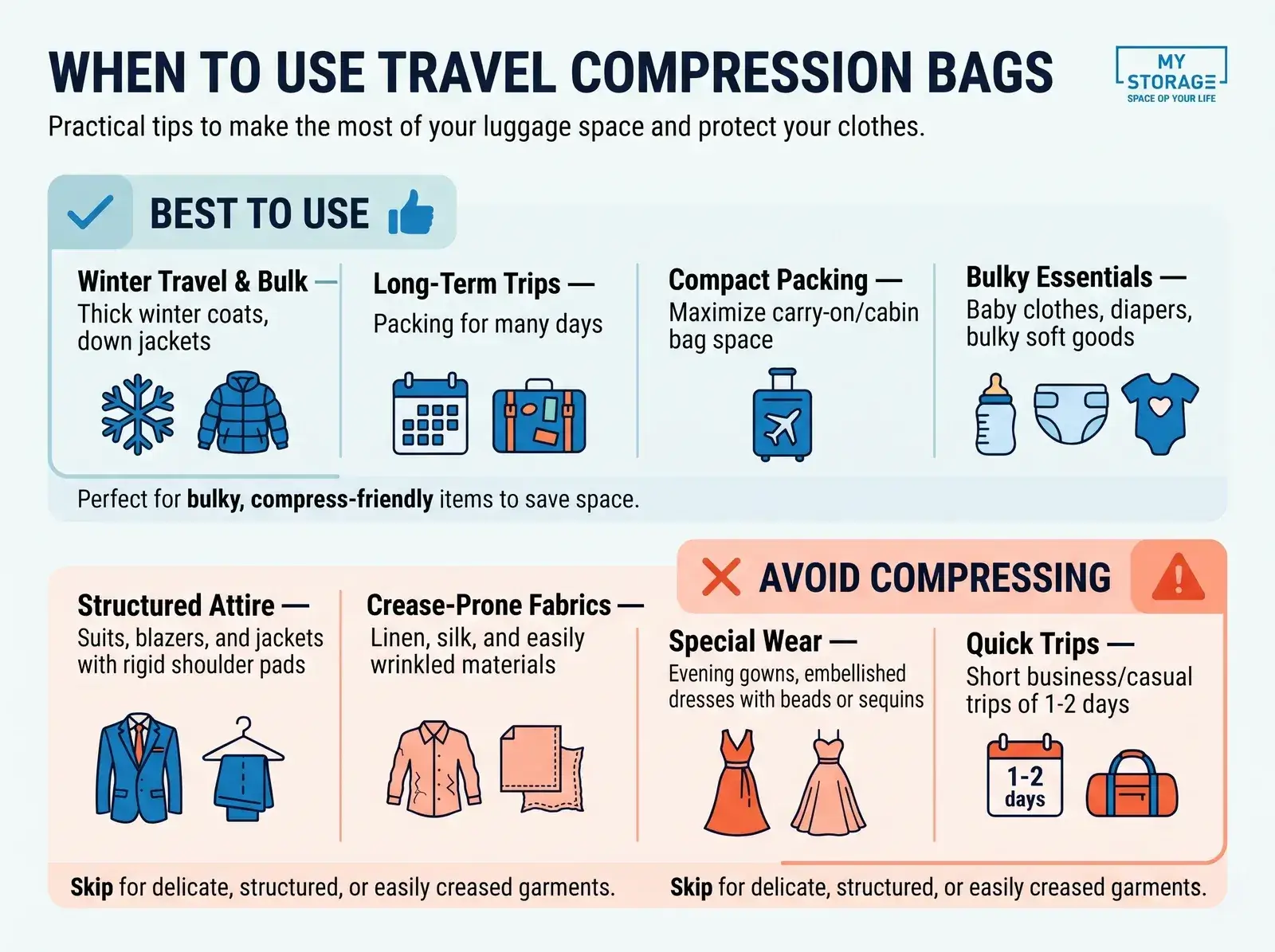
Packing cubes make a suitcase noticeably tidier and better organised, but only the double-zip mechanical compression type really reduces the physical volume of thick, bulky clothes.
| Type Of Cube | What It Does |
|---|---|
| Ordinary fabric packing cubes | Remove dead space in the suitcase and let you find things instantly without unpacking everything |
| Compression cubes (second zip) | Reduce the volume of sweaters, hoodies or warm clothes by 25% to 40% |
A set of 4 to 6 packing cubes costs about 200,000 to 400,000 VND (≈ US$8 to US$16) and is a worthwhile investment for anyone who travels 2 or more times a year.
Compression cubes are worth using only for thick, bulky items such as sweaters and hoodies, while thin clothes are fine in ordinary fabric cubes, and when to use compression bags when travelling goes into each situation.
Is It Okay To Re-Wear Clothes On A Trip?
Re-wearing clothes while travelling is completely normal and practised by most experienced travellers, as long as you follow the right principles: change right after sweaty activity and prefer antibacterial fabrics.
- Outer jacket: can be worn 4 to 5 days in a row.
- Jeans or chinos: 2 to 3 days if you are not doing intense physical activity.
- Cotton T-shirts: change after 1 day.
- Merino wool T-shirts: can be worn again the next day if they still smell fresh.
This is not a question of social norms but a practical decision that helps you travel lighter and save a lot on baggage costs.
Check In Or Carry-On For A Suitcase?
For a 7-day trip, carry-on luggage is the optimal choice if you are not bringing bulky winter clothes and do not plan to buy much to bring back, because it saves time waiting at the carousel and avoids checked-baggage fees.
| Criterion | Carry-On | Checked |
|---|---|---|
| Leaving the airport | 15 to 20 minutes after getting off the plane | 30 to 60 minutes waiting at the carousel |
| Fee | No checked-baggage fee | 150,000 to 400,000 VND per direction (≈ US$6 to US$16) depending on weight and Vietnamese low-cost airline |
| Two return flights | Saves 300,000 to 800,000 VND (≈ US$12 to US$31) | Fees apply to each flight |
| Choose when | You are not bringing bulky winter clothes and do not plan to buy much | You are bringing winter clothes, large sports equipment or plan to buy a lot to bring back |
Down jackets and winter clothes take up a lot of volume but are used only a few weeks a year, so seasonal storage describes how to rotate them between home and a unit so the wardrobe does not overflow.
Where Can You Leave A Suitcase While Travelling?
The three most common ways to leave a suitcase while travelling are: a smart locker at Ministop (for a few hours), asking the hotel to hold your luggage (usually free for guests) and a professional luggage storage service such as MyStorage self-storage for longer periods.
- Ministop locker 24/7: fastest and most convenient for leaving luggage from a few hours up to two days while moving around inner Ho Chi Minh City.
- Hotel: most let guests who have stayed leave luggage free after check-out if you ask politely.
- MyStorage pickup & delivery: ideal for travellers who need to move a suitcase from one place to another without dragging it themselves, especially with several pieces or heavy items.
Things you will not use for the next three months are the group to leave behind rather than carry, and 8 groups of household items worth storing lists them by how often you use them.
Travellers in transit for a few hours also need somewhere to leave a suitcase before their next flight, and transit in Saigon with 6 to 12 hours and your luggage compares ways to handle it by waiting time.
Does MyStorage Store Travel Luggage?
Yes, MyStorage offers storage for suitcases and travel luggage in air-conditioned self-storage, with options from small lockers to mini units rented flexibly by the month.
The service suits three situations best:
- Storing an empty suitcase after a trip, when you do not want it taking up room in a small apartment.
- Storing luggage during a house move or renovation.
- Storing part of your belongings that you do not need immediately when you have just moved to Ho Chi Minh City.
Contact MyStorage directly for advice on the unit size that suits your number of luggage pieces and storage period.
A renovation needs somewhere to store both suitcases and belongings, and storing belongings during a home renovation sets out how to split items into groups. People who have just moved from another province into Ho Chi Minh City usually do not have a home right away, so their belongings must wait somewhere for a few weeks, and storing belongings when you move to Ho Chi Minh City without an apartment compares three ways to handle it.
An empty suitcase does not have to be useless once put away, and 7 ways to use a suitcase for storing things sets out ways to reuse it. Leaving Saigon for Tet also raises the question of where to put things in the apartment, and storing belongings when leaving Saigon for Tet 2027 goes through each group of items.
All reference prices follow the Ho Chi Minh City market for 2027. Actual prices may change depending on the time and each provider’s policy.
Related articles
Article
Logistics Trends For 2027: Automation, AI And Green Warehouses
Logistics trends for 2027 rest on three pillars: warehouse automation, AI for demand forecasting and green warehouses meeting ESG standards. Small and mid-sized businesses should…
Read article
Article
Moving To HCMC: Where Your Shipment Goes Before You Have An Apartment 2027
Moving to Ho Chi Minh City before the lease is signed? This guide follows an international shipment from Cat Lai Port and Tan Son Nhat through customs clearance into storage-in-transit…
Read article
Article
Do Packing Cubes Really Make A Suitcase Tidier? How To Use Them And Store Luggage 2027
Packing cubes keep a suitcase tidy and easy to search, but only mechanical compression cubes actually reduce the volume of clothes; this guide compares three types of bag, how to pack them…
Read article
