
 Tiếng Việt
 한국어
 日本語
Article
Logistics Trends For 2027: Automation, AI And Green Warehouses
On this page
Logistics trends for 2027 turn on three pillars: warehouse automation, artificial intelligence for demand forecasting, and green warehouses that meet ESG standards. This guide covers each pillar, the specific technology involved, the costs to budget for and a rollout path by company size, with a checklist for auditing your current warehouse setup.
Most small and mid-sized businesses do not start with robots; they start by moving stock out of the home or office, a transition stage described in managing inventory when selling online from home.
The Market Picture Behind Logistics Trends For 2027
The logistics market in 2027 is shifting from labour-intensive operations to supply chains built on real-time data and sustainability commitments. Pressure from cross-border e-commerce and emissions rules is pushing companies to restructure warehousing and transport rather than simply rent more floor space as they did in earlier cycles. 2027 is also when two ideas that used to sit apart meet: digital logistics operations and governance under ESG (Environmental, Social and Governance) standards. Leading companies treat green standards not as a compliance burden but as a lever for energy savings and investment appeal.
Trade volume is the base for any warehousing forecast. According to figures released by Vietnam’s Ministry of Industry and Trade at the Autumn Economic Forum in October 2026, total import and export turnover reached US$930.06 billion in 2025, up 18.2%; the first nine months of 2026 reached US$888.03 billion, up 30.4% year on year.
Freight volume rose more than 16% over the same period, with road transport still carrying about 75.7% of tonnage. That imbalance drives both cost and emissions, which is why multimodal transport features heavily in national strategies.
Three Forces Driving Change In Warehousing
Three pressures are pushing warehousing to move faster at once: labour cost, delivery expectations and green technical barriers. None of them is temporary, so companies can only absorb them by changing the structure of operations rather than by adding overtime or seasonal staff. The three forces are: Each one pushes in the same direction, toward fewer manual touches per order.
- Labour cost and supply: warehouse labour costs rise every year while turnover among seasonal staff at peak stays high, pushing companies toward machines.
- Expectations of very fast delivery: online buyers want same-day or same-hour delivery, which demands very high accuracy in order processing at the warehouse.
- Global green technical barriers: major export markets such as the European Union and North America are tightening carbon border rules and require transparent emissions data across storage and transport.
Cost pressure shows up most clearly in picking, where staff spend much of a shift walking between racks. Before considering robots, many warehouses recover part of that time simply by relocating fast-moving items, the approach set out in arranging a warehouse scientifically.
Cost pressure also shows at the level of the whole economy. The Vietnam Logistics Report 2025, cited by the Ministry of Industry and Trade, estimates logistics costs at roughly 16 to 17% of GDP, while noting this is an economy-wide indicator, not the cost ratio of every sector or company.
Demand For Modern Warehouses And Industrial Property
Demand for modern warehouses with technology infrastructure and green building certification is growing faster than for older, low-grade stock, according to Asia industrial property reports from JLL and Savills. The rent gap between the two keeps widening, and old warehouses are hard to re-let without upgrading floors, clear height and electrical systems.
That gap also raises the build-or-rent question, two options with very different cost structures, which renting a ready-built warehouse versus building your own works through item by item. The link between industrial capital flows and warehousing demand is analysed further in logistics and industrial real estate.
Green Logistics In The Vietnamese Context
In Vietnam, green logistics is emphasised in national logistics service strategies to lift the competitiveness of domestic goods. For exporters this is no longer just encouragement: importing partners often ask for emissions figures before signing long-term contracts, so operating data has to be ready in advance. The direction is now written into policy. The national logistics service strategy for 2025 to 2035 with a vision to 2050, approved under Decision 2229/QĐ-TTg dated 9 October 2025, sets a target that by 2035, 80% of logistics companies will use digital transformation solutions, tying digitalisation to emissions reduction.
The paperwork involved is dense, from Incoterms to transport document codes, so 150+ import, export and logistics terms is a useful reference when working with overseas partners.
Warehouse Automation In Logistics Operations
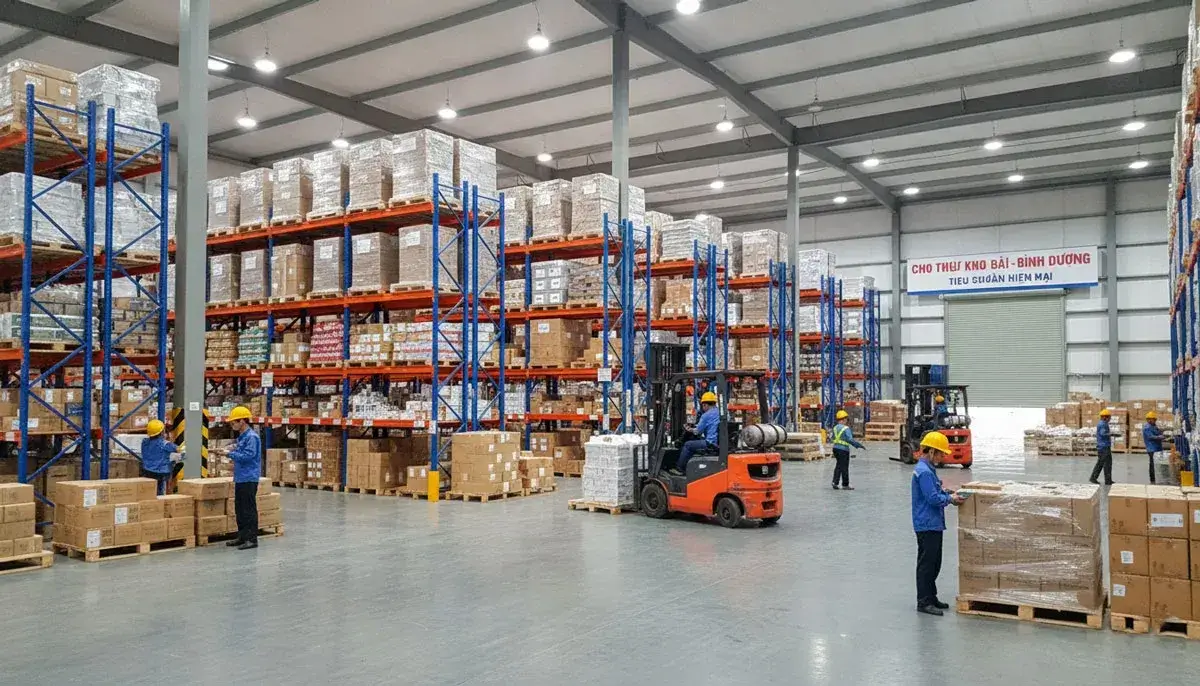
Automation in 2027 centres on autonomous mobile robots (AMRs), automated storage and retrieval systems (AS/RS) and Internet of Things sensors that raise order accuracy. Together they cut reliance on manual handling and raise storage density on the same floor area, especially in warehouses with high ceilings that still stack only two levels of racking.
Automation is no longer the preserve of huge distribution centres. With equipment rented by the month or for peak season, mid-sized companies can upgrade one step at a time without heavy upfront capital, usually starting at picking or labelling.
The pace of adoption is measurable. The International Federation of Robotics reported in September 2026 that nearly 250,000 professional service robots were sold in 2025, up 24%, with transport and logistics alone accounting for 117,500 units, up 21% and holding a 47% share. Close to half of all units sold exist to move goods.
Autonomous Mobile Robots And AS/RS Racking
Autonomous mobile robots and automated storage and retrieval systems take over movement and picking without demolishing existing infrastructure. Most of the value comes from cutting the time staff spend walking to find goods, which dominates a picking shift. The two groups differ in how they run: Both work alongside existing racking rather than replacing the building.
- Autonomous mobile robots (AMR): use LiDAR sensors and cameras to map space, detect obstacles and bring racks to the packing station. Unlike older AGVs that follow fixed magnetic tape, AMRs are easy to add to or reroute when the layout changes.
- Automated storage and retrieval systems (AS/RS): use cranes or shuttles running on rails between high racks, making the most of ceiling height to raise capacity per square metre of floor.
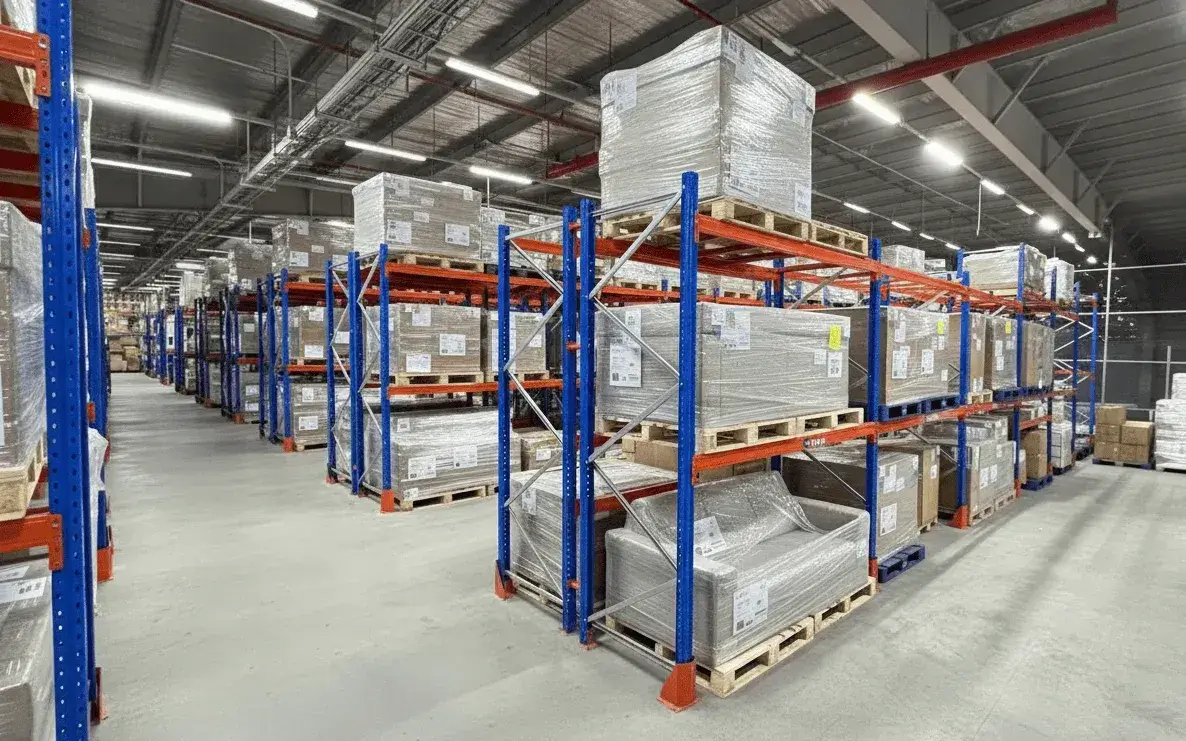
To exploit height, racking and pallets must match on load and dimensions, and choosing wooden, plastic or steel pallets compares each type by goods and warehouse conditions. When capacity is measured by height rather than floor area, storage priced by m³ versus m² shows how the same goods can produce very different invoices.
Warehouse design is changing with it. Gartner forecast in April 2026 that by 2030, 50% of new warehouses in developed markets will be designed as robot-centric facilities with people handling only exceptions, as cost and labour supply stay under pressure.
Inventory Management With IoT And RFID
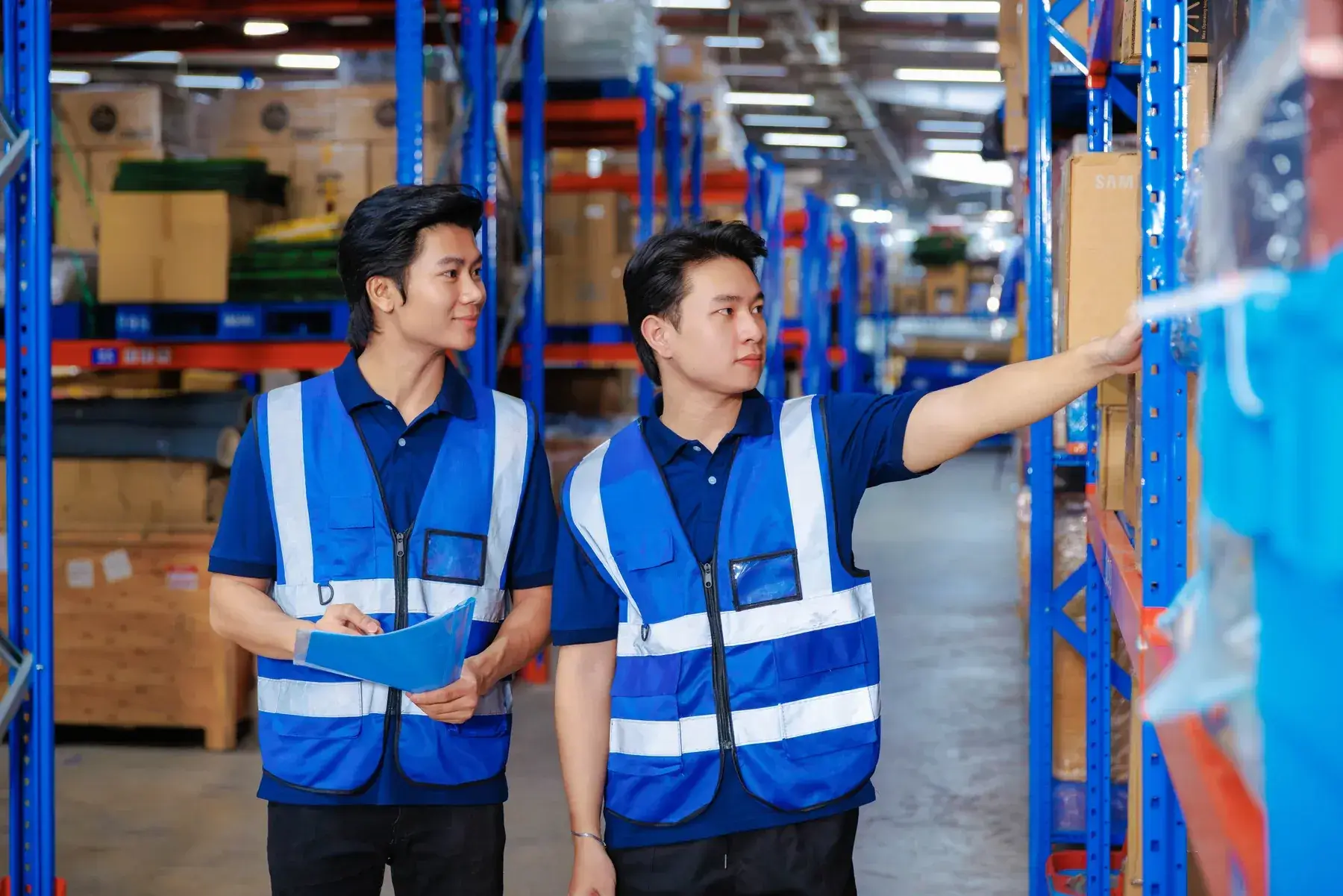
IoT sensors and radio frequency identification tags track location, temperature and humidity in real time. Physical data syncs continuously into the warehouse management system without scanning each carton, so stock figures in software stay close to reality on the floor. Two applications stand out: The gain is accurate stock figures without extra scanning labour.
- High-speed automatic stocktaking: RFID gates at the dock read hundreds of cartons in the seconds a forklift passes, cutting discrepancies in stock records.
- Monitoring storage conditions: environmental sensors alert immediately when temperature or humidity passes a safe threshold, which matters most for electronics, pharmaceuticals, cosmetics and packaged food.
Sensor types and alert thresholds are detailed in IoT in warehouse management, while cycle counting describes splitting the warehouse into small counting rounds instead of closing for a full count. For dated goods, sensor data only helps when the issue rule is right, which FIFO and FEFO explains by product group.
Sorting Processes For E-commerce Orders
High-speed automatic sorting handles the very large volumes of single-item orders that e-commerce generates in promotional peaks. This is the familiar bottleneck in multichannel retail warehouses, where an order holds one or two items but order counts multiply within days. Two common technologies: Both reduce the number of decisions a picker has to make under time pressure.
- Pick-to-light and voice picking: guide staff to the right SKU and quantity through lights on the rack or a headset, shortening training time for new hires.
- Smart sorting conveyors: sort parcels by carrier and geographic zone right after labelling, reducing misrouted deliveries.
Peak season also raises returns, so the returns area needs to be separate from the start, following the process in handling returned goods. For shops that sell and livestream, warehouse space combined with livestreaming sets out how to place the filming area next to packing.
Costs And A Rollout Path For Automation
Automation only pays back when order volume is steady, so the first question is not which robot to buy but how many orders you ship a day and what your current error rate is. Below a few hundred orders a day, most of the gain comes from standardising SKUs, relocating racks and using barcode scanners, at a fraction of the cost of an automated line.
Once manual throughput hits its ceiling, automate one step at a time in order of contribution: picking, then labelling, then sorting. A warehouse management system (WMS) is the prerequisite before any equipment, because robots need accurate location data. Companies without a WMS can start with a stock-in and stock-out file in Excel and fix formula problems using the guide to Excel errors and locking data.
AI In The Supply Chain And Warehouse Management
AI in logistics for 2027 acts as the coordinating brain: forecasting demand, optimising transport routes and predicting equipment failures. Instead of reacting after a problem appears, the system proposes inventory and routing changes from historical data plus live movements, letting managers decide days earlier. Machine learning models now learn from a company’s own operating data, so forecast quality depends more on clean inputs than on the algorithm. A messy SKU catalogue produces skewed forecasts no matter how expensive the software is.
The technology priorities analysts set out point the same way. Gartner published eight supply chain technology trends for 2026, led by polyfunctional robots, physical AI combining AI models with IoT sensors, agentic AI able to plan and execute, and multiagent systems that coordinate several AI agents in one workflow.
Demand Forecasting And Inventory Levels
Machine learning reads sales history, seasonality and market trends to estimate how much stock each location needs. Accurate forecasts let a company hold a safe buffer without tying up cash in slow-moving goods. Two concrete benefits: The output is a reorder quantity per SKU rather than a single figure for the whole catalogue, which is what makes it usable day to day.
- Less capital tied up: avoids over-ordering slow sellers that occupy storage space and drag on cash flow.
- Stock positioned near buyers: suggests moving goods to satellite warehouses near rising demand before orders appear, shortening delivery time.
Safe stock levels also set the space you rent, so better forecasting usually drops a company one size band. calculating CBM for goods converts cartons into volume before choosing a unit, and how mini storage prices are calculated breaks the rate into its parts.
Optimising Last-Mile Delivery Routes
Smart routing calculates the shortest distance using traffic conditions, truck-restricted hours and the density of delivery points. Last mile is usually the costliest leg in the chain, so every percent of distance saved shows up directly in cost per order. Two main mechanisms: Both run on the same trip data a company already collects from its drivers.
- Dynamic dispatch in real time: updates a driver’s route when congestion, bad weather or an address change appears.
- Vehicle load optimisation: works out how to stack the truck by drop order, last drop loaded first, to cut unloading time at each stop.
When goods move straight from one vehicle to another without entering racking, cross-docking removes another handling step. For goods that must stay chilled end to end, cold chain logistics sets out the temperature points to control.
Digital Twins And Predictive Maintenance
A digital twin simulates the whole warehouse in a virtual environment so scenarios can be tested before they are applied. A manager can see the effect of an order spike or a new rack layout without disrupting live operations. Two common uses: Both rely on sensor data the warehouse already generates during normal operation.
- Testing movement flows: spots congestion between forklifts, robots and staff during peak hours.
- Predictive maintenance: analyses vibration, temperature and power draw from conveyors and refrigeration to schedule service before a sudden failure.
Gartner advises supply chain officers to use digital twins and simulation from the design stage, before construction, to validate layouts and tune robot fleet performance rather than find bottlenecks once the building is fixed.
Equipment monitoring sits close to warehouse building systems, the scope that IFM in warehouse management describes service by service. Cameras and access control run on the same data infrastructure, as warehouse security systems analyses layer by layer.
The Data Foundation AI Needs
AI is only accurate on clean foundations: one unique code per product, consistent units, and stock synced between sales channels and the warehouse. Multichannel sellers usually trip over one product carrying three different codes on three platforms, which splits and skews the forecast at the input stage. That cleanup needs no expensive software, just one pass through the catalogue and a coding convention applied to every channel. Warehouses serving several owners, like the shared warehouse model, need a single coding convention from the first day of intake.
Green Warehouses And ESG Standards In Logistics
A green warehouse meeting ESG standards uses renewable energy, environmentally friendly materials and emission-reducing processes across its operating life. For 2027 this is a criterion for joining multinational supply chains, since many partners write it into contract terms rather than merely encouraging it. Green logistics is not about planting trees around the yard. It is a measurable technical standard covering energy performance, water management and industrial waste control, with figures that must be exportable into a report.
Legal pressure from export markets has moved into the mandatory phase. The European Union’s carbon border adjustment mechanism applies in its definitive regime from 1 January 2026, after a transitional phase from 2023 to 2025, with obligations covering authorisation, reporting and the purchase of certificates for embedded emissions in imported goods.
Green Building Certification For Warehouses
International certifications such as LEED from the US Green Building Council, EDGE from the International Finance Corporation or LOTUS assess energy savings and carbon reduction in warehouse infrastructure. With certification, owners and tenants can evidence environmental commitments with figures instead of statements. Two groups of items are usually scored: Certification is assessed on measured performance, not on design intent alone.
- Renewable energy and smart lighting: rooftop solar combined with natural skylights and LED fittings with motion sensors along each racking aisle.
- High-performance insulation: certified roofing and partition insulation that reduces load on air conditioning and keeps warehouse temperature steadier.
Stable temperature is not only about saving power; it decides the quality of goods stored long term, particularly textiles and leather, the group whose storage conditions handbag and leather goods storage sets out.
Sustainable Packaging And Reverse Logistics
Circular packaging and a tight reverse logistics process cut plastic packaging waste and recover returns efficiently. In e-commerce, waste from cartons, tape and foam is a leading environmental concern and also a cost that repeats with every order. Two directions: Both cut recurring cost per order as well as waste volume, which is why they usually pay back faster than infrastructure projects.
- Friendlier packaging materials: replace hard-to-degrade bubble wrap with recycled honeycomb paper, bio-based air pillows or reusable plastic crates for internal routes.
- A lean reverse logistics process: set up a separate returns inspection area to sort quickly and repack sound items back onto the selling shelf, cutting what has to be destroyed.
Reusable crates need storage when empty, so space for empty packaging belongs in the warehouse plan from the start. The inspection and restocking steps are described in the returns handling process.
Green Transport For Inner-City Delivery
Switching to electric trucks and motorbikes for the last mile cuts carbon emissions and noise directly in large cities. It goes hand in hand with planning charging points at the transit warehouse yard, since charging time has to fit the window when vehicles wait for goods. Two common approaches: Both depend on charging capacity being planned together with the delivery schedule.
- Optimised consolidated trips: pair electric vehicles with order-grouping algorithms to limit empty return runs.
- Satellite warehouses in the city: place small storage points near residential areas so small electric vehicles deliver within a short radius.
A city satellite point is often only a few cubic metres per product group, so many shops use a self-storage unit near their customers as a transit point, the approach described in storing livestream stock when space at home is tight. For companies with plants on the outskirts, storage in Phu Nhuan is an example of a transit point close to the centre.
Measuring Emissions And ESG Reporting
An ESG report only convinces when it rests on real measurements: monthly electricity use, kilometres driven, packaging weight and the share of waste recycled. Start with the three easiest to measure, the power bill, vehicle distance and cartons purchased each month, then widen the scope. This does not need expensive systems at first, only a monthly tracking sheet kept up consistently. After twelve months of figures, it becomes clear which item deserves investment first, and business storage in Ho Chi Minh City helps compare rental types by real operating cost.
A Rollout Path For Small And Mid-Sized Businesses
Small and mid-sized businesses should convert in stages, from standardising data to digitising management and then optimising storage space, rather than spreading investment thin. Flexible storage keeps fixed costs under control in a volatile market, because rented space can expand and shrink with the selling season instead of being locked for years.
Not every company needs autonomous robots or a million-dollar automated warehouse. A sensible path starts with cleaning the SKU catalogue, standardising stock-in and stock-out processes, and only then choosing a storage model that matches actual scale.
Three Stages In Order Of Priority
The three stages run in sequence because each is the condition for the next: clean data, then digitisation, then automation. Companies that skip the first stage usually have to redo the whole catalogue after the software is live, which costs twice the time. The order is: Skipping a stage usually means repeating it later at higher cost.
- Standardise data: review the SKU catalogue, unify units of measure and set a coding convention for every sales channel.
- Digitise management: move stock-in and stock-out into software and sync inventory between marketplaces and the physical warehouse.
- Optimise space, then automate one step at a time: rearrange racks by pick frequency before considering equipment for the tightest bottleneck.
Comparing The Path By Company Size
The same trends apply very differently to an online shop and to a distribution chain, mainly in equipment spend and the type of warehouse rented. The table below sets four implementation criteria against two size groups so you can place your business before setting a budget. Place your business in one column before setting any budget figure.
| Implementation criterion | Small business, online shop | Mid-sized business, distribution chain |
|---|---|---|
| Level of automation | Label printer, basic barcode scanner and standard racking | Sorting conveyor, electric forklifts and AMR pilots |
| Data and AI | Multichannel sales software with stock alerts | WMS, demand forecasting software and transport routing |
| Storage solution | Self-storage with flexible space by season | Standard industrial warehouse or a third-party logistics (3PL) partner |
| Green priority | Less plastic packaging, recycled paper fill, consolidated deliveries | Certified green warehouses and electric trucks in the city |
Small businesses usually struggle most with where to put stock, especially when it sits in an apartment or living room, a situation that renting an apartment as a warehouse analyses for both legality and risk. When industrial space is quoted in feet, the 5x5 and 10x10 feet conversion table gives a quick comparison in square metres.
A Readiness Checklist For Your Warehouse
Before committing to investment, review four foundation items to see what is missing. The table sets out what to check and the standard to meet for each, and works as an internal checklist to run every quarter. The four items are data infrastructure, warehouse processes, space optimisation and environmental standards.
| Item | What to check | Standard to meet |
|---|---|---|
| Data infrastructure | SKU coding, inventory synced between sales channels and the warehouse | Stock updated in real time, discrepancy under 1% |
| Warehouse processes | Flow from receiving, storage, picking and packing to dispatch | One-directional flow, no crossing, FIFO or FEFO applied |
| Space optimisation | Floor fill rate, rack height, stock separated from living areas | Height used well, aisles clear for trolleys |
| Environmental standards | Packaging materials, temperature, humidity and lighting control | Limited single-use plastic, dry storage area, efficient power use |
Staffing deserves review at the same time, since each warehouse role has its own requirements, as warehouse job positions lists by group. Separating stock from living areas is the minimum hygiene condition for cosmetics and food.
MyStorage Self-Storage For Small Businesses And Online Sellers
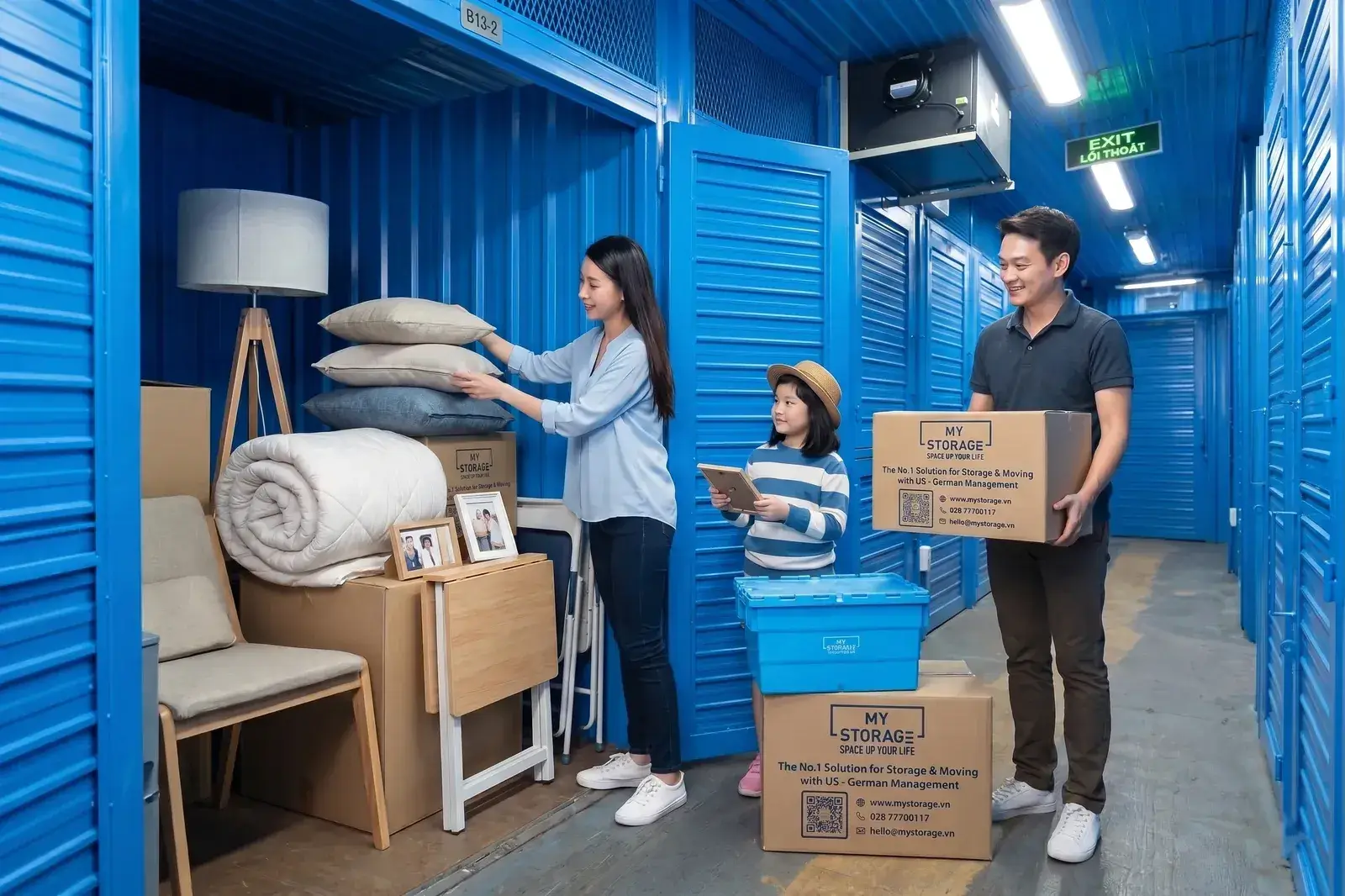
For startup teams or online sellers who do not yet need an automated warehouse, the leanest first step is separating stock from the office and the home. MyStorage units start at 1 m³, about 8 to 10 medium cartons, with a 2027 reference price of 873,000 to 1,563,000 VND (≈ US$34 to US$61) a month for units of 1 m³ to 3 m³, excluding VAT:
- Air-conditioning 24/7 keeps temperature and humidity steady for textiles, cosmetics and electronics.
- Security cameras monitor the unit area throughout the rental.
- Personal PIN issued to each customer, so only the authorised person opens the unit.
- 24/7 access, which suits the evening packing rhythm of online shops.
- Units from 1 m³, scaling with the selling season instead of a fixed yearly lease.
- Workspace at 375 Vo Nguyen Giap so startups and online sellers can store stock and pack orders on site.
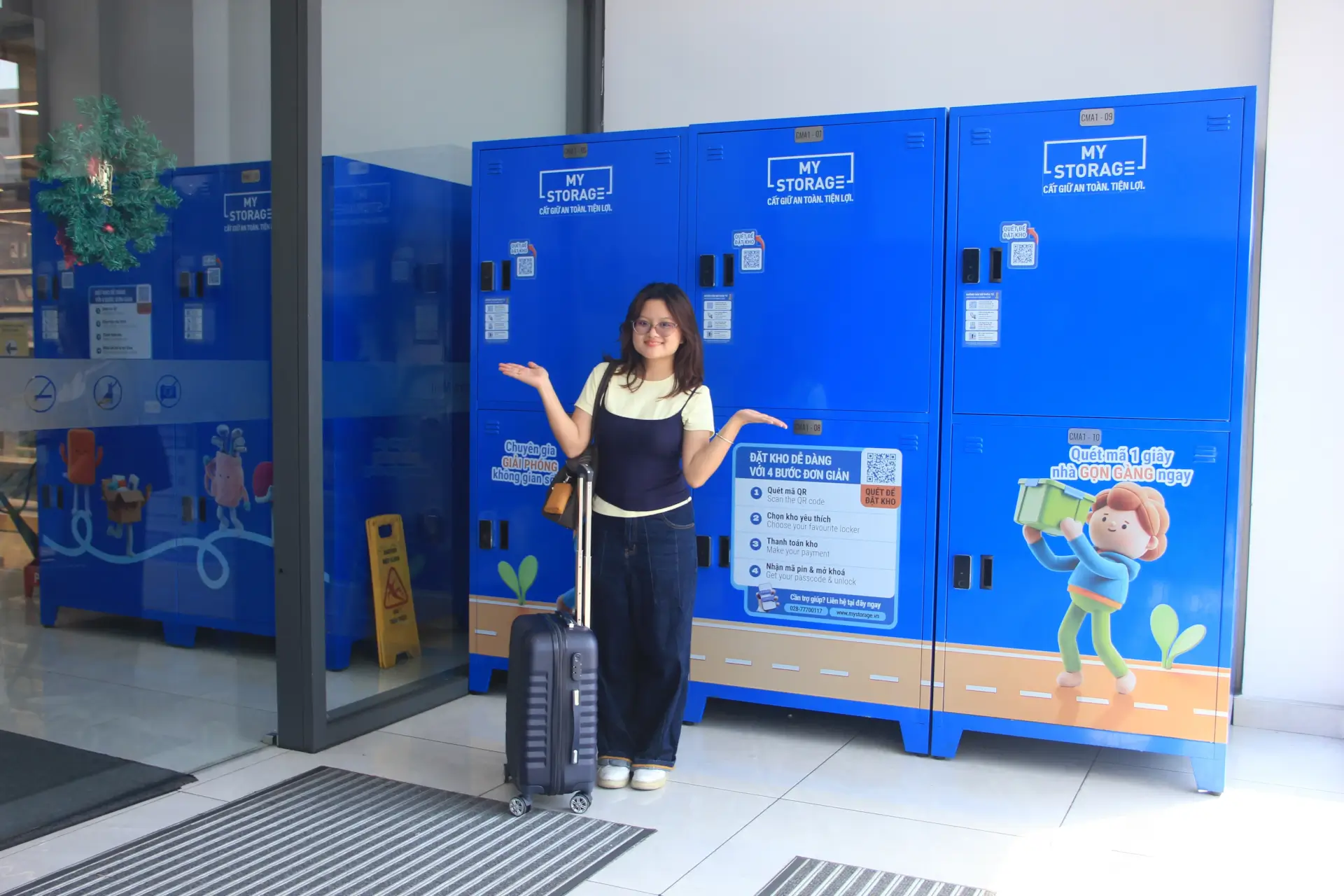
MyStorage has two self-storage facilities, 375 Vo Nguyen Giap and An Phu Sports Park; locker points are for small items and are not storage facilities. The 12-month plan is 15% cheaper than the flexible plan. Payment is in VND and exchange rates change. Companies weighing a private warehouse against shared infrastructure can compare with the fulfillment warehouse model, while personal mini storage fits while volumes are small and uneven.
Frequently Asked Questions About Logistics Trends For 2027
The answers below cover 15 common questions on warehouse automation, AI, green warehouses and storage choices for small and mid-sized businesses in 2027.
What Do Logistics Trends For 2027 Focus On?
Logistics trends for 2027 focus on three pillars: warehouse process automation, AI in supply chain coordination and green warehouses meeting ESG standards. The three support each other in solving faster delivery, lower labour cost and emissions rules. On technology, Gartner ranks polyfunctional robots, physical AI and agentic AI among the leading supply chain trends for 2026.
How Do E-logistics And ESG Standards Connect?
E-logistics provides the digital data layer that measures and makes environmental indicators transparent under ESG standards. Through warehouse management and routing software, a company can calculate power consumption, cut empty running and track packaging waste, producing sustainability reports with real figures for partners.
Should A Small Business Invest In Automation?
A small business should not pour money into robots or automated lines at the start; it should begin by digitising inventory management. Order management software with barcode scanners and sensible rack planning already raises throughput considerably at reasonable cost, without pressuring operating cash flow.
How Does AI Support Inventory Forecasting?
AI reads transaction history, seasonal search trends and market movements together to suggest the right intake quantity per SKU. That avoids the two risks at either extreme: running out during peak, or holding stock so long that storage costs mount and value falls.
What Are The Benefits Of A LEED-certified Green Warehouse?
A LEED-certified green warehouse saves on long-term power and water costs and strengthens credibility with international brands. Designs that use natural light, good insulation and rooftop solar cut carbon emissions and also create a more open, safer working environment for warehouse staff.
How Do AMRs Differ From Older AGVs?
AMRs recognise space for themselves and avoid obstacles flexibly, while older AGVs run on fixed rails or magnetic tape on the floor. With smart sensors, AMRs let a company expand the fleet or change the rack layout without re-doing the floor, so the cost of later changes is far lower. Demand is rising fast: IFR recorded 117,500 transport and logistics robots sold in 2025, up 21% and 47% of all professional service robots.
How Can You Cut Emissions In Last-Mile Delivery?
Companies cut last-mile emissions with route-based order grouping, electric delivery vehicles and satellite warehouses near residential areas. When the distance from storage point to recipient shortens and first-attempt delivery success rises, emissions per parcel fall to their lowest level.
How Are Digital Twins Used?
A digital twin creates a virtual model running alongside the real warehouse so scenarios can be tested before rollout. A company can simulate the effect of a mega-promotion and check coordination between staff and handling equipment, spotting bottlenecks early without risking disruption to live operations.
Is Converting To A Green Warehouse Expensive?
Upfront investment in green warehouse infrastructure is usually higher than for a conventional building, but it is offset by energy savings over the asset’s life. For small and mid-sized businesses that do not build their own warehouse, the cheapest route is renting space in a green project where the developer has already completed certified infrastructure.
What Does RFID Do For Warehouse Management?
RFID reads data from many cartons at once by radio, without needing line of sight to the label as barcodes do. It shortens periodic stocktakes from days to hours and raises accuracy when tracing the location of each batch inside the warehouse.
What Is The Role Of Reverse Logistics In 2027?
Reverse logistics is a core link in the circular economy, handling returns, packaging reuse and end-of-life disposal to standard. A fast returns process lets an e-commerce business put intact products back on the selling channel, reducing lost revenue and waste.
How Do ESG Standards Affect Exports?
Large importers in Europe and the US increasingly require suppliers to evidence ESG compliance and emissions control as a condition of contract. Companies that adopt green warehousing and transparent transport data hold a clear advantage in keeping international customers and widening export share. For the European market, the CBAM entered its mandatory regime on 1 January 2026, so emissions data is now required paperwork rather than a bonus.
Does Green Packaging Raise Packing Costs?
The unit price of some environmentally friendly packaging can be slightly above conventional plastic, but it offsets that by optimising parcel weight and reducing waste disposal fees. When box sizes are standardised to fit the product, less void fill is consumed, so total packing cost per order barely moves.
When Should A Company Upgrade Its WMS?
Upgrade the WMS when SKU counts rise fast, mis-picks exceed the acceptable threshold, or you need to sync with several marketplaces at once. A modern WMS assigns storage locations automatically, manages expiry under FEFO and produces accurate operating performance reports.
Which Storage Solution Is Flexible For Small Businesses?
Self-storage with flexible rented space is the best fit for small and mid-sized businesses in 2027. The model allows storage space to expand or shrink with the selling season, avoiding wasted spend on a fixed long-term lease while keeping security and standard storage conditions.
Prices in this article are 2027 reference prices, excluding VAT. Market figures are cited with the organisation that published them and the date; trends and forecasts may change in later updates from those organisations.
Related articles
Article
How Many Clothes Do You Need For A 7-Day Trip? How To Pack Light 2027
How many clothes do you need for a 7-day trip? The 4-2-7 formula (4 tops, 2 bottoms, 7 sets of underwear and socks) keeps your suitcase light, with a full packing list, fabric and colour…
Read article
Article
Moving To HCMC: Where Your Shipment Goes Before You Have An Apartment 2027
Moving to Ho Chi Minh City before the lease is signed? This guide follows an international shipment from Cat Lai Port and Tan Son Nhat through customs clearance into storage-in-transit…
Read article

Article
Do Packing Cubes Really Make A Suitcase Tidier? How To Use Them And Store Luggage 2027
Packing cubes keep a suitcase tidy and easy to search, but only mechanical compression cubes actually reduce the volume of clothes; this guide compares three types of bag, how to pack them…
Read article
